By Eytan Shander, The Prediction Network · Prices pulled 8:31 a.m. ET
Kalshi has Democrats at 67 cents bid, 68 cents ask to control the Senate after November 3. Polymarket is the same price to the penny. That contract has moved one way all year: Republicans were 56% in March, Democrats took the lead for the first time on September 14, and it kept climbing to 69 at Thursday’s close before slipping to 67.5 at the midpoint this morning.
Here is the problem with 67.5. It is within a point of the number you get if you treat the twelve Senate races most likely to decide control as twelve independent weighted coins at their own market prices. (South Carolina, where Decision Desk HQ gives the Democrat 30%, is the closest race left off.) Senate races are not independent. When the polls miss, they miss in the same direction in every state at once. Price that in, and the majority Democrats are being sold at 67.5 cents is a bet that the polls don’t miss toward Republicans by more than 1.6 points.
The setup
- Republicans hold 53 seats. Democrats need a net gain of four. At 50-50, Vice President Vance breaks the tie, so 50 is a loss.
- North Carolina is a near-lock at 96 cents. After that Democrats need three more flips from Ohio, Texas, Maine, Alaska, Iowa, Kansas and Nebraska, while holding Michigan, Georgia, New Hampshire and Minnesota.
- Four of those flips trade between 64 and 76 cents. The polling averages behind them are leads of 1.2 to 2.9 points.
The ladder: what the market pays for each seat
Every number below is a live two-sided market. Kalshi and Polymarket agree on all twelve to within three cents, so this isn’t one book’s quirk.
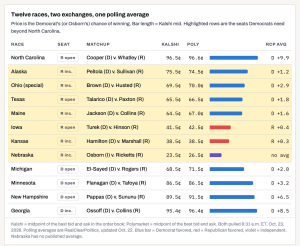
68.5 cents is the independence price, if Osborn votes with Democrats
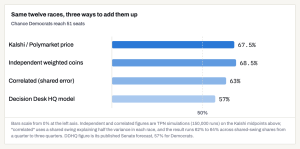
We ran the ladder 150,000 times. If each race is decided by its own coin at the Kalshi price, Democrats reach 51 seats 68.5% of the time. That is a point above the market, and it assumes Dan Osborn wins Nebraska and sits with Democrats. That’s not a given. Osborn has said repeatedly he won’t caucus with either party (“Independent means independent,” he said at a press conference reported Oct. 17), though he’s also said he’d “caucus with everybody,” and Republicans argue he’d side with Democrats anyway. Without Nebraska the independence price is 63%, below the market.
Now let the races share a common error, the way they did in 2020. With a shared swing that explains half the variance in each race, the same ladder produces a Democratic majority 63% of the time, a coincidence: it matches the no-Osborn independence figure above but comes from a different calculation. Decision Desk HQ’s model, which simulates that correlation properly, puts it at 57%. Three views of the same twelve prices, and the exchange sits within a point of the most bullish way to add them up.
The 1.6-point line
Forget simulations and just move the polls. North Carolina is safe at nearly ten points. The next four flips sit at Ohio +2.9, Texas +1.8, Maine +1.6 and Alaska +1.2, and the seat Democrats most need to hold, Michigan, is at +2.0. Shift every average the same amount toward Republicans and watch the majority fall apart in order. Market prices don’t track poll margins in that order, though: Alaska at D +1.2 trades at 75.5 cents and Ohio at D +2.9 at 69.5 cents, so the uniform swing is a stress test, not a forecast.
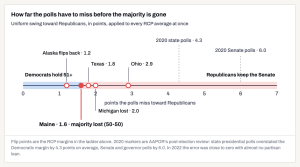
A miss of 1.6 points, less than half of 2020’s, turns 52 Democratic seats into 50. That is the entire majority. In 2022 the polls were as accurate as they have been since the 1990s, and if that repeats, Democrats sweep Ohio, Texas, Maine and Alaska and finish at 52 if the polls are exactly right, or at 54 if they understate Democrats by even half a point, because Iowa (R +0.4) and Kansas (R +0.3) flip too. The control contract is not really a bet on any candidate. It is a bet on which of those two polling years November looks like.
Where the value is
The side: “No” on Democratic Senate control, 33 cents on Kalshi (Republicans “Yes,” 32 cents on Polymarket). You are paying 33 cents for an outcome that a correlated read of the exchange’s own prices puts at 37 cents and DDHQ puts at 43 cents. Depth on this side is thinner than the headline volume suggests: about $22,000 is offered at 33 cents, $100,000 at 34 cents and $35,000 at 35 cents. Work a limit order instead of paying up.
Play “No” up to 34 cents. Rest a limit bid at 35 cents if you want more. Pass above that.
Why not buy the flips themselves? Because that’s paying three times for one bet. Buying Paxton at 35 cents, Susan Collins (Maine) at 36 cents and Sullivan at 25 cents on Kalshi pays three spreads for three bets that win or lose together. If the polls miss toward Republicans, one 33-cent contract on control captures the whole move. If you believe the opposite, that 2022 repeats, the logic runs the other way: correlation does not change what a single race is worth, Democrats finish at 52 cents or better if the polls are right, and “Yes” on control at 68 cents captures that in one contract instead of several spreads.
What breaks it. Polling error cuts both ways, and the market has moved with the polls all fall. If the averages are already understating Democrats, as they did in 2022, Democrats land at 52 cents if the polls are exactly right and up to 54 cents if they understate Democrats by even half a point, and this contract goes to zero. Treat it as a bet against independence, not a call on the candidates.
Read the fine print
Kalshi doesn’t settle this on seat count. It pays on the party of the Senate president pro tempore on Feb. 1, 2027, and the rules don’t say what happens if an independent caucuses with no one. If Osborn wins and stays unaligned in a 50-49-1 Senate, the chamber’s organizing vote decides it, and that’s a case the seat math scores as a Democratic win. That case leans toward “No.” The model also ignores three other independents, Brian Bengs in South Dakota, Todd Achilles in Idaho and Seth Bodnar in Montana, who aren’t on the ladder. An upset by any of them cuts the other way.
Sources
Kalshi order books, 8:31 a.m. ET, Oct. 23, 2026: Senate control (CONTROLS-2026), state race markets (SENATEOHS-26, SENATETX-26, SENATEME-26, SENATEAK-26, SENATEIA-26, SENATEKS-26, SENATENE-26, SENATEMI-26, SENATEGA-26, SENATENH-26, SENATEMN-26, SENATENC-26). Prices are midpoints of best bid and ask; depth is resting dollars.
Polymarket, same time: Which party will win the Senate in 2026? and the state winner markets.
Kalshi News, Oct. 16, 2026: Who Will Control the Senate in 2026? (Republicans 56% in March; Democrats first led Sept. 14).
RealClearPolitics, 2026 Senate polling averages, updated Oct. 22, 2026, as reproduced by Election Central.
Decision Desk HQ, Senate forecast, updated Oct. 22, 2026, 2:18 p.m. ET (Democrats 57%, Republicans 43%).
AAPOR, Task Force on 2020 Pre-Election Polling: signed error 4.3 points (state presidential), 6.0 points (Senate and governor).
Pew Research Center, Aug. 28, 2024, Key things to know about U.S. election polling, citing FiveThirtyEight on 2022 accuracy.
Nebraska Examiner, Oct. 17, 2026: Osborn’s independence continues to be scrutinized in Nebraska Senate race.
Roll Call, Sept. 24, 2026: Who would this independent caucus with? ‘Everybody’.
Kalshi, Senate control contract terms (payout on the party of the President Pro Tempore on Feb. 1).
Vox, Oct. 1, 2026: Senate elections 2026: The independents running in Nebraska, South Dakota, Idaho, explained.
Simulation method: each race drawn from its Kalshi midpoint; correlated runs use a Gaussian copula with a shared national factor. Nebraska counted as a Democratic-aligned seat only if Osborn wins. Seat counts approximate the contract. Independent candidates in South Dakota, Idaho and Montana are not modeled; those seats are counted Republican. Kalshi settles on the pro tem’s party (contract terms). Not investment advice.