
Midterm prediction markets moved almost entirely in one direction this week. Ten of the 11 biggest one-week swings in Senate and governor’s races went toward Democratic candidates. The lone exception was Alaska, where Republican Sen. Dan Sullivan gained 6 percentage points.
The final week brings new data. In-person early voting ended Friday in Texas and Nevada, and campaigns now have actual turnout numbers, not just polls. This story ranks the biggest moves and explains what’s behind each one.
Methodology: Senate moves are seven-day changes on Kalshi as of Oct. 31, via DeFi Rate. Governor moves are one-week changes as of Oct. 30, via ElectionOdds. Kalshi gives Democrats a 70% chance of winning Senate control.
The board: biggest one-week moves
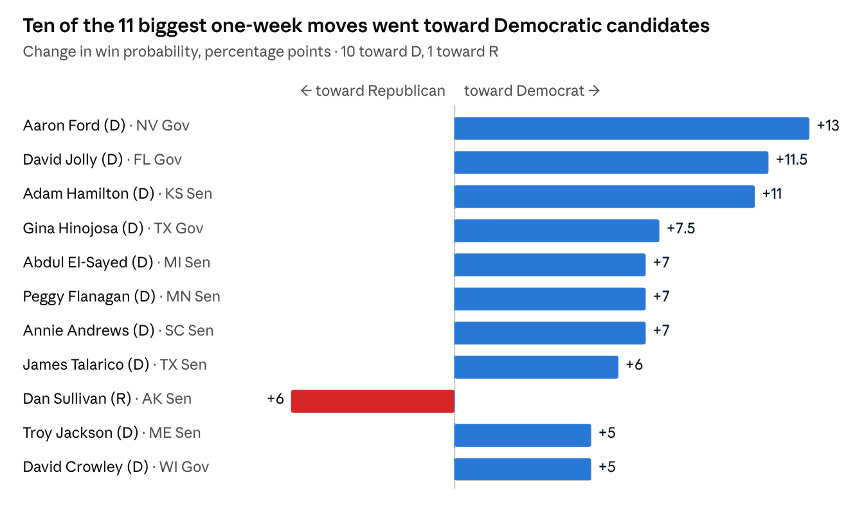
Three of the four biggest moves came in governor’s races, led by Nevada. Sullivan is the only Republican candidate on the board who gained ground.
Senate: Where the odds moved
Kansas had the week’s biggest Senate move. Democrat Adam Hamilton rose from 40% to 51% on Kalshi and is now a slight favorite. Below is each race, ranked by the size of its move, with what the public record shows behind it.
Building momentum
- Adam Hamilton, D-Kan. — 51%. Polls had been close for weeks: YouGov had Hamilton up 48-45, and InsiderAdvantage had him ahead 47.5% to 46.7%. Sabato’s Crystal Ball shifted the race to a tossup on Oct. 14. No single event this week explains the jump, which suggests the market is catching up to the polls. Kansas hasn’t elected a Democratic senator since 1932.
- Abdul El-Sayed, D-Mich. — 76%. That’s an all-time high for El-Sayed in his race against former Rep. Mike Rogers. Neither tracker cites a reason for the move.
- Lt. Gov. Peggy Flanagan, D-Minn. — 91%. Flanagan was already a heavy favorite, so her move says less than the others.
- Annie Andrews, D-S.C. — 28%. Andrews is up about 7 points but remains a long shot. Expect thin trading at this price.
- State Rep. James Talarico, D-Texas — 71%. This is the clearest case for the early-vote theory. More than 6 million Texans, about 32% of registered voters, cast early ballots. Voters with a history of voting in Democratic primaries slightly led early turnout, according to The Texas Tribune. One Republican consultant called that new territory compared with 2022 and 2024. A CNN/SSRS poll the same week had Talarico ahead 49-43. Attorney General Ken Paxton fell to a record-low 30% on Thursday, the same day Vice President JD Vance campaigned for him in Weatherford, Texas.
- Troy Jackson, D-Maine — 69%. An InsiderAdvantage poll of 1,200 likely voters had Jackson, a former Maine Senate president, leading Sen. Susan Collins 49-47.
- Smaller moves: State Rep. Josh Turek, D-Iowa, rose 2 points to 45%. Former Sen. Sherrod Brown, D-Ohio, rose 2 points to 71%.
Losing ground
- Sen. Roger Marshall, R-Kan. — 49%, the biggest Senate drop.
- Mike Rogers, R-Mich., and Ken Paxton, R-Texas — Rogers slid to about 24%. Paxton hit a record low of 30% on Thursday.
- Former Rep. Mary Peltola, D-Alaska — 70%, down 6 points. She is the only Democrat to lose ground. The drop followed a New York Times report on allegations that political operatives associated with Peltola’s campaign and national Democratic organizations worked to recruit candidates who might draw votes away from the incumbent.
- Sen. Susan Collins, R-Maine — 31%, down about 5 points.
Sullivan’s 6-point gain in Alaska is the only race this week where the odds moved toward the Republican.
Governor: Nevada posts the biggest move
Nevada Attorney General Aaron Ford gained 13 points this week, the biggest one-week move in any governor’s or Senate race. In every governor’s race covered by the weekly data, the big moves went toward the Democrat.
Building momentum
- Aaron Ford, D-Nev. — 79.5%. Ford is up 13 points this week and 32 points over the past month against Republican Gov. Joe Lombardo. Early voting ran Oct. 17-30. The most recent public poll cited in the tracker’s write-up was from September and had Lombardo up 2 points, so the market has moved well past the public polling. That pattern is consistent with traders acting on early-vote data, but no published turnout data confirms it.
- Former Rep. David Jolly, D-Fla. — 30.5%. Jolly is up 11.5 points but remains the underdog against Rep. Byron Donalds. The latest polls have tightened: St. Pete Polls had Donalds up 2.3 points (Oct. 25-27), and a New York Times/Siena College poll had him up 4 (Oct. 19-25).
- State Rep. Gina Hinojosa, D-Texas — 38.5%. Hinojosa is up 7.5 points, with the same early-vote picture as the Texas Senate race. Gov. Greg Abbott remains the favorite at about 62%.
- Milwaukee County Executive David Crowley, D-Wis. — 85.5%. Crowley is up 5 points in his bid to hold the seat for Democrats against Rep. Tom Tiffany.
Losing ground
- Gov. Joe Lombardo, R-Nev. — 19.5%, down 14 points. That’s the steepest drop for any incumbent on the board.
- Rep. Byron Donalds, R-Fla. — still favored at 69.5%.
- Gov. Greg Abbott, R-Texas, and Rep. Tom Tiffany, R-Wis. — Each lost about as much ground as his opponent gained.
The overall governor count shifted too. The market on the total number of Republican governors now gives a 39.5% chance that there will be fewer than 22, up 11.5 points in a week. Republicans now hold 26 governorships.
What to watch before Nov. 3: final early-vote totals in Texas and Nevada, weekend polls in Kansas and Maine, and whether Hamilton holds above 50% in Kansas.