
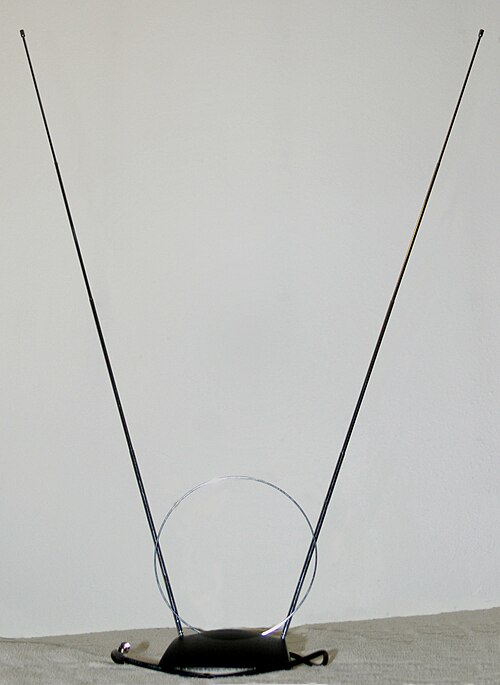
Terrestrial television
Terrestrial television, or over-the-air television (OTA), is a type of television broadcasting in which the content is transmitted via radio waves from the terrestrial (Earth-based) transmitter of a TV station to a TV receiver having an antenna. This type of TV broadcast is distinguished from newer technologies, such as satellite television, in which the signal is transmitted to the receiver from an overhead satellite; cable television, in which the signal is carried to the receiver through a cable; and Internet Protocol television, in which the signal is received over an Internet stream or on a network utilizing the Internet Protocol. Terrestrial television stations broadcast on television channels with frequencies between about 52 and 600 MHz in the VHF and UHF bands. Since radio waves in these bands travel by line of sight, reception is generally limited by the visual horizon to distances of 64–97 kilometres, although under better conditions and with tropospheric ducting, signals can sometimes be received hundreds of kilometers distant.
Read more on Wikipedia